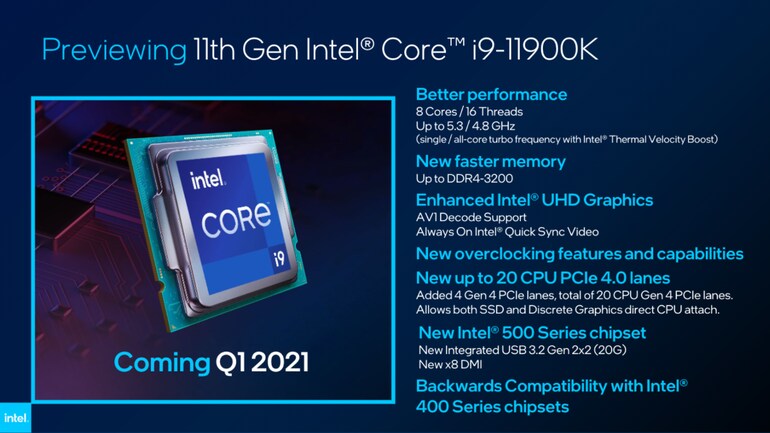
Intel has announced that its flagship Core i9-11900K chipset will arrive within the half-moon of 2021 at the CES 2021. The chipmaker previewed the upcoming 11th-generation Rocket Lake S chipsets for desktops which will combat AMD’s Zen 3 chipsets that were launched last year. Intel has claimed that its new chips will have 50 per cent better integrated graphics while the instructions per cycle are going to be bumped up to 19 percent higher. and eventually , there'll be better AI performance on Intel’s upcoming flagship processor.
For the new Core i9-11900K chipsets, Intel took a page from its old playbook and moved back to the eight-core performance supported the 14-nanometre architecture. This seems underwhelming ahead of the 10-nanometre process but Intel is touting its new Cypress Cove cores that bring the performance improvement of the 10nm process to the 14nm, allowing faster speeds without having extra cores. the present 11th-generation models have 10 cores with 20 threads but Intel says the general performance of the Rocket Lake S chipsets are going to be better comparatively.
The top-end model, the Core i9-11900K has an eight-core, 16-thread chipset that features a boosted speed of 5.3GHz. there's support for DDR4 RAM with a frequency of 3200MHz and a complete of 20 PCIe 4.0 lanes for storage. Intel is additionally touting backward compatibility on the upcoming chipset with the Intel 400 Series chipsets, like the Intel Core i9-10900K. Previously, the Core i9-11900K visited the Geekbench 5 benchmarking platform where it resulted in an 18 per cent improvement in single-core performance over the Core i9-10900K processor, which suggests the upcoming Intel processor goes to be significantly faster.
However, while Intel is promising a bright way forward for desktops with the Rocket Lake S chipsets, AMD is already ready with the ammunition. The rival chipmaker had launched the Zen 3 microarchitecture for desktop chipsets, like the Ryzen 5000 series and therefore the Ryzen 4000 series is additionally expected to feature the Zen 3 architecture soon. In benchmark results performed in December last year, the Zen 3-based Ryzen 5800X chipset outperformed an early version of the Rocket Lake S chipset with significant differences within the single-core and multi-core performance. But these scores don't think about the performance boost that the Cypress Cove cores will bring. And this new technology from Intel goes to be a game-changer for desktop processors.
In addition to announcing the launch timeline for the Rocket Lake S chipset, Intel teased the 12th-generation Alder Lake processors and launched four new processor families for notebooks. It launched the new 11th-generation vPro mobile processors for ultralight business laptops that bring 23 per cent performance improvements over the last generation chipsets. For gaming laptops, Intel launched the 11th-generation H-series CPUs with TDP (Thermal Power Design). the bottom TDP of those processors is 28W but it can go up to 35W with the boost. Intel also launched the Evo vPro and N-Series Pentium Silver and Celeron processors for normal business and education markets.

No comments:
Post a Comment
Note: only a member of this blog may post a comment.